
MUSIC ENSEMBLES
EDITION #1
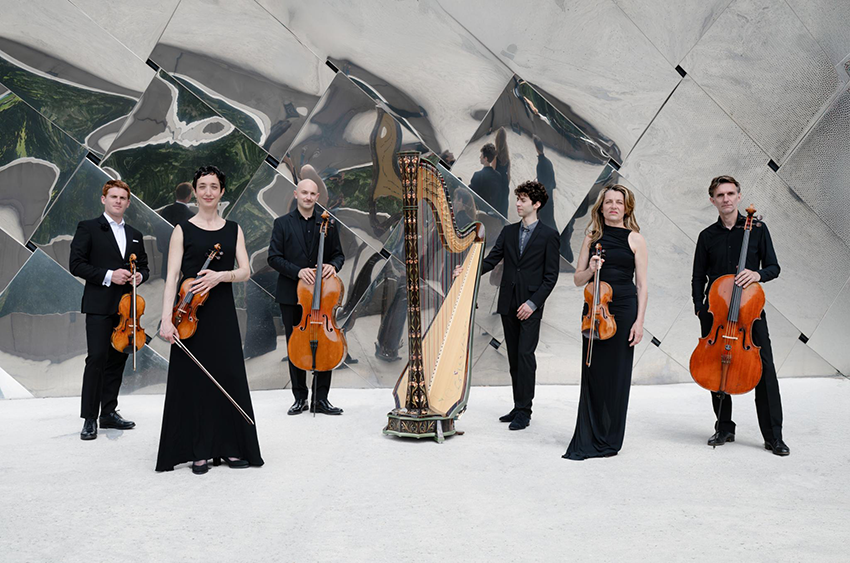
Ensemble Des Équilibres
Taking unconventional paths, escaping labels, and approaching music as a space for exchange form the foundation of Des Équilibres’ artistic vision. Founded in 2006 by violinist Agnès Pyka, who serves as its artistic director, this flexible ensemble encourages dialogue between musicians from diverse backgrounds, musical aesthetics, and artistic disciplines.
True to its exploratory mission, Des Équilibres spans the entire chamber music repertoire, from the classical period to contemporary creations, with particular attention to rare or unpublished works. Its adaptable instrumentation—from recitals to octets depending on the program—allows the ensemble to tackle a broad musical corpus and actively promote new creation through regular commissions. The ensemble has developed projects combining repertoire and new works, such as commissions for Philippe Hersant, Nicolas Bacri, and Graciane Finzi alongside Brahms’ violin and piano sonatas, as well as collaborations with Florentine Mulsant and Bryce Dessner.
In 2024, Des Équilibres continues this commitment with several creation projects, notably works for violin, cello, and harp that juxtapose contemporary pieces with those of Henriette Renié. The same year, the France Europe Express Magyarország program brings together Hungarian and French composers for a tour in France and Hungary. This momentum continues with the European Trans Europe Express project (2024–2026), dedicated to promoting female creation through commissions for eight European women composers and developed in partnership with multiple cultural institutions.
Alongside its focus on new creation, the ensemble champions the classical repertoire through thematic programs and complete cycles, such as the 2022 cycle of César Franck’s chamber music for strings. It also develops programs blending classical and contemporary works, exemplified by En compagnie de l’instrument préféré de Mozart, centered on the violin-viola duo.
Collaboration with other art forms is central to the ensemble’s identity. Des Équilibres regularly develops multidisciplinary projects combining music, dance, theater, visual arts, or video, such as the production Une Nuit transfigurée. These collaborations reflect a constant effort to expand chamber music into new artistic territories.
Since its creation, the ensemble has established itself as a recognized actor on the international music scene. Tours across four continents foster intercultural encounters and inspire original projects that blend different musical traditions. Notable collaborations include projects with artists from Algeria, Israel, Turkey, as well as Still Point with pianist and composer Ray Lema, exploring the connections between chamber music, jazz, and African sonorities, and Fado Em Movimento, which brings together contemporary creation and the traditional Fado repertoire.
Des Équilibres also develops a significant educational mission through artistic residencies and pedagogical initiatives for diverse audiences, including schools and underserved communities. These take the form of workshops, masterclasses, conferences, public rehearsals, and participatory projects.
The ensemble’s discography reflects its commitment to discovery and creation, including critically acclaimed recordings of Sandor Veress, Bartók, Weinberg, César Franck, as well as original projects blending contemporary creations with repertoire works. These recordings have received numerous awards and international nominations.
Supported by the Île-de-France Region, Des Équilibres is a member of FEVIS and SCÈNE ENSEMBLE.
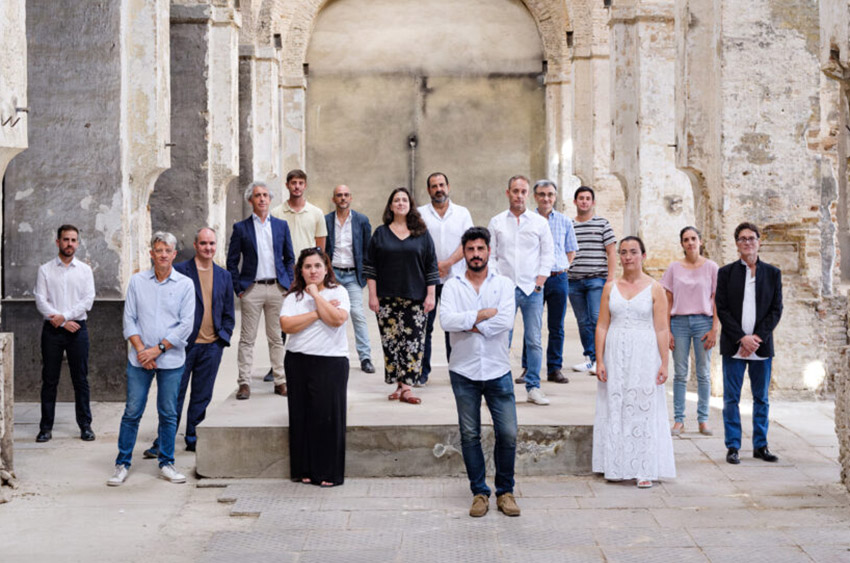
Zahir Ensemble
From its inception, the Zahir Ensemble immediately attracted the interest of young Spanish and international performers, experienced or not, all committed to exploring and showcasing the richness of 20th- and 21st-century music. The ensemble tackles even large-scale works for chamber orchestra thanks to its versatile configuration. The Seville-based group demonstrates a dedication to performing the vast, stylistically diverse, and historically significant repertoire of our time—often absent from conventional programming.
To illustrate the ensemble’s national and international reach beyond its members, it is worth noting its participation in European festivals and venues such as the Taschenopern Festival in Salzburg (Austria), the Crossroads Festival at the Solitär Saal of the Mozarteum University (Salzburg), Musique en Cité(s) (Marseille, France), and the concert hall of the Chopin University in Warsaw (Poland). In Spain, the ensemble has performed in the Contemporary Music Cycle of the Seville City Hall, Música Contemporánea de Córdoba, the Arts No Camiño Festival in Lugo, the A orillas del Guadalquivir International Music Festival in Sanlúcar de Barrameda, the Seville Guitar Festival, the Mostra Sonora de Sueca in Valencia, the Ensems Festival in Valencia, the Smash Festival in Salamanca, the Ciclo de Música Para el Tercer Milenio in Madrid, the Proyecto Rafel Festival (Rafelbunyol, Valencia), among others. They have also performed in prestigious venues such as the Teatro Villamarta in Jerez, the Círculo de Bellas Artes in Madrid, the Auditorium 400 of the Reina Sofía Museum in Madrid, the Royal Academy of Fine Arts of San Fernando in Madrid, the Juan March Foundation in Madrid, the Teatro de la Maestranza in Seville, the Conservatory of Bilbao, and the Alhambra Theatre in Granada.
Particularly notable is the ensemble’s long-standing presence at the Ciclo de Música Contemporánea de la Junta de Andalucía at the Teatro Central in Seville (2007–2008 and 2010–2019), where it presented Spanish premieres of works such as The Fall of the House of Usher by Philip Glass, In vain by G. F. Haas, ASKO Concerto by Elliott Carter, Ballet mécanique (original version) by G. Antheil, Proverb by Steve Reich, and Clouds of Forgetting, Clouds of Unknowing by John L. Adams.
The ensemble also organizes its own concert season in Seville (with support from the University of Seville), which is celebrating its 15th edition this year. It has released seven CDs, including monographs dedicated to José María Sánchez Verdú (Verso, 2009), recognized as “Exceptional Album of March 2010” by Scherzo magazine, another devoted to Schönberg (Naxos, 2011), and two CDs featuring young Spanish composers (2010 and 2011), published by Injuve. Recently, Zahir began a collaboration with the IBS Classical label, releasing Anatomies devoted to Luis de Pablo (2019), and two monographs dedicated to Eneko Vadillo (Anima, 2020) and César Camarero (A Liquid Theatre, 2021). Upcoming projects include a CD of works for piano and ensemble by Reinhard Febel and Leoš Janáček, as well as a recording of vocal and ensemble works by Argentine composer Alberto Ginastera, featuring Natalia Labourdette (soprano) and Jesús Povedano (baritone).